“Complete and balanced.” It is the most reassuring phrase on any pet-food label — and the least examined. We read it as a guarantee and stop thinking. But complete is a precise idea with a real definition, and once you understand it, two things happen: you can tell a genuine meal from a clever one, and you stop worrying that every single bowl has to be perfect.
Here’s what “complete” actually means, what goes into one, and where the honest word is complementary instead.
“Complete” vs “Complementary”: The Distinction the Label Won’t Explain
Strip away the marketing and there are only two kinds of food in the bowl:
- A complete food is formulated to supply all the essential nutrients your pet needs for its life stage, in the right proportions. It can be fed as the sole diet, day after day, and the animal will not go short.
- A complementary food is designed to be fed alongside other things. On its own it is not nutritionally complete — and that’s not a flaw, it’s a job description. A tripe topper, a pure-organ mix, a bone broth, a single-protein mince: excellent food, not a whole diet.
Neither is “better.” A complementary tripe is one of the best things you can add to a bowl — it just isn’t the bowl. The error is feeding a complementary food as if it were complete, and assuming biology will sort out the gaps. It won’t.
This is also why the wording on a properly made product matters. A meal that meets the full nutrient profile is complete; one that doesn’t is complementary — and where a recipe needs topping up to hit the profile, the honest phrase is “with added vitamins and minerals,” never “fortified” or “enriched.” Those last two are regulated, threshold-based claims, and most real food doesn’t need them.
The Building Blocks of a Complete Raw Meal
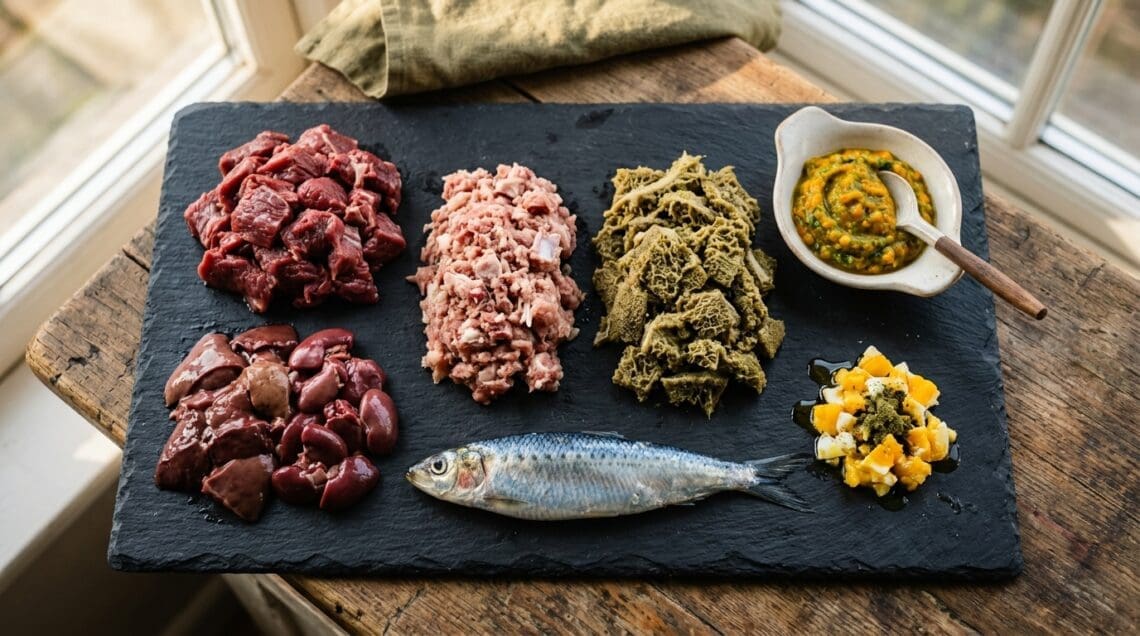
A species-appropriate diet for a dog or cat is built from real, whole foods — preferably raw. The components aren’t arbitrary; each one is doing a specific job.
1. Protein: muscle meat, organs and bone
Protein is the backbone of the meal, and the proportions reflect what these animals actually are. In a healthy diet, protein makes up roughly 75% for a dog and around 88% for a cat — the cat, an obligate carnivore, sits even further along the spectrum than the dog.
But “protein” here doesn’t mean a slab of steak. It means muscle meat, organs and bone together:
- Muscle meat — the primary protein and amino-acid source.
- Organs — concentrated nutrition (liver, kidney, heart); the densest part of the meal.
- Bone — finely ground, the natural source of calcium and phosphorus.
That last point carries the most weight, literally. Correct bone and teeth formation depends on the calcium-to-phosphorus ratio landing between 1:1 and 1.5:1. Hit that with ground bone in the recipe and you don’t need a synthetic calcium fix bolted on afterwards. (Veterinarian Tom Lonsdale has long argued the case for raw meaty bones in carnivore diets, including their role in dental health.)
2. Fats — and the omega-3s that are easy to miss
A complete meal carries low to moderate animal fat, scaled to the animal’s activity level, plus a meaningful supply of the omega-3 fatty acids EPA and DHA. These are the ones diets most often fall short on. Oily fish — sardines, for example — are a direct, whole-food source, which is why a regular sardine in the rotation does real work rather than just adding calories.
3. Why processing matters: digestibility, not “dead food”
You’ll often hear that raw food is “alive” with enzymes and cooked food is “dead.” It’s a tidy story, but it isn’t how digestion actually works: your pet’s body makes its own digestive enzymes — in the saliva, stomach, pancreas and gut — and most enzymes present in food are broken down by stomach acid before they could do anything useful. So we won’t lean on that claim.
The defensible point is simpler and better evidenced: how food is processed changes how much of it your pet can actually use. High-heat extrusion — the process that turns ingredients into shelf-stable kibble — alters proteins and degrades some heat-sensitive nutrients along the way. Peer-reviewed feeding trials have found raw and minimally-processed diets to be more digestible than extruded kibble, with dogs passing smaller, firmer stools — a practical sign that more of the meal is being absorbed rather than passed through. That, not an “enzyme bank account,” is the real reason raw and heavily-cooked food aren’t interchangeable even when the ingredient lists look alike.
4. Vitamins and minerals — whole-food first
A complete diet has to cover the full spectrum of vitamins and minerals, and there are two ways to get there: from whole foods, or from isolated, added supplements. Real raw ingredients carry an enormous range of them — for instance, B-vitamins and vitamin A are richly present across liver, kidney, heart, eggs, and oily fish like salmon and sardines.
The body appears to use some naturally-occurring nutrients well — but we won’t claim whole-food vitamins are always better absorbed than synthetic ones. For some nutrients the two are equivalent, and for a few the synthetic form is actually taken up more easily. The honest case for whole food is different: it delivers nutrients in their natural matrix, alongside the other compounds they travel with, rather than depending on a synthetic premix bolted on to rescue what heavy processing stripped out. Processed foods need that premix; a whole-food diet largely doesn’t. Where a recipe genuinely can’t reach a target from food alone, the right approach is a measured addition — stated plainly as “with added vitamins and minerals,” not dressed up as fortification.
5. Fibre: not a nutrient, still essential
Dogs don’t strictly need fibre, but a growing consensus is that it earns its place. Fibre is the part of plants that can’t be digested — zero calories, passing through largely unchanged — yet it does several quiet jobs along the way:
- It regulates stool. Fibre absorbs water like a sponge: it firms up loose stools by soaking up excess water, and eases constipation by drawing water in. It helps keep the gut working steadily in both directions.
- It feeds the good bacteria. Fibre acts as a prebiotic — a food source for the friendly intestinal bacteria that aid digestion and crowd out harmful ones.
- It slows things down. By delaying gastric emptying, fibre gives a slow, steady release of energy — useful for steady blood sugar and for animals on a weight-management plan, because high-fibre meals keep them feeling fuller on fewer calories.
A small amount of pureed vegetable and a little fruit is enough — this is a carnivore’s diet with a supporting cast, not a salad.
6. The case for tripe (and what to look for)
If one ingredient ties this whole list together, it’s green tripe — the stomach of a grazing animal like a cow or sheep. It is the closest thing to a complete-meal component in a single food:
- it carries digestive enzymes — more available enzymes means more of the meal’s vitamins, minerals and energy actually get absorbed;
- it contains partially-digested greens, unlocking plant nutrients in a form your carnivore could never extract by eating grass itself;
- it has a near-perfect calcium-to-phosphorus ratio and a good omega-3 to omega-6 balance;
- it’s mildly acidic, which makes it gentle on sensitive stomachs.
If you feed it, look for tripe that is minimally processed (fresh, then frozen, then freeze-dried) and locally sourced where possible, for production and safety standards. The smell is the price of admission.
Do You Need “Complete and Balanced” in Every Single Meal?
No — and this is the idea that takes the pressure off. You don’t eat a perfectly balanced plate at every meal; you balance over time. The same logic applies to a healthy pet on a varied raw diet.
There are two schools of thought on variety. One says: feed a single complete, balanced, life-stage-appropriate diet and nothing else — pets have no nutritional requirement for variety. The other says: rotate, because animals in the wild ate differently by season, and a pet used to different proteins and textures is far easier to switch later if a medical diet ever becomes necessary.
The practical middle is balance achieved across the week, not micro-managed at every bowl. Rotate protein sources, vary the organ content between meals, add a complementary food like tripe or a raw meaty bone periodically. A genuinely complete base diet gives you the freedom to add to it without “unbalancing” anything — a healthy animal takes what it needs.
One word of care on fillers: cheap recipes pad protein figures with legumes and peas rather than meat. The practice has drawn scrutiny from veterinary nutrition voices such as Dr W. Jean Dodds, and it’s a good reason to read past the protein percentage to where the protein comes from. A complete carnivore meal does its work with no grains or starches — it doesn’t need them.
Key Takeaways
- ✅ “Complete” = supplies every essential nutrient for the life stage and can be the sole diet. “Complementary” = made to feed alongside other food. Both are valuable; don’t feed a complementary food as if it were complete.
- ✅ The honest label words are “with added vitamins and minerals,” never “fortified” or “enriched.”
- ✅ Protein is muscle meat + organs + bone — roughly 75% of a dog’s diet, ~88% of a cat’s.
- ✅ Calcium:phosphorus belongs at 1:1–1.5:1, naturally supplied by ground bone.
- ✅ Processing changes what your pet can use: raw and minimally-processed diets test as more digestible than extruded kibble (smaller, firmer stools) — the real reason raw ≠ cooked.
- ✅ Whole food supplies vitamins in their natural matrix — not necessarily “better absorbed,” but without relying on a synthetic premix to replace what processing strips out.
- ✅ Fibre is a prebiotic that steadies stool and slows energy release; a little pureed veg is enough.
- ✅ Green tripe is the standout complementary food: enzymes, unlocked greens, near-perfect Ca:P.
- ✅ Balance over the week, not every bowl — a complete base diet gives you room to add variety safely.
Go deeper:
- The bigger picture: Why Raw Food for Dogs (see What’s actually in it)
- The What and Why of Organ Meat · Tripe, the Magical Mystery Meat
- Anatomy of a Real Food Diet · Probiotics for Cats and Dogs