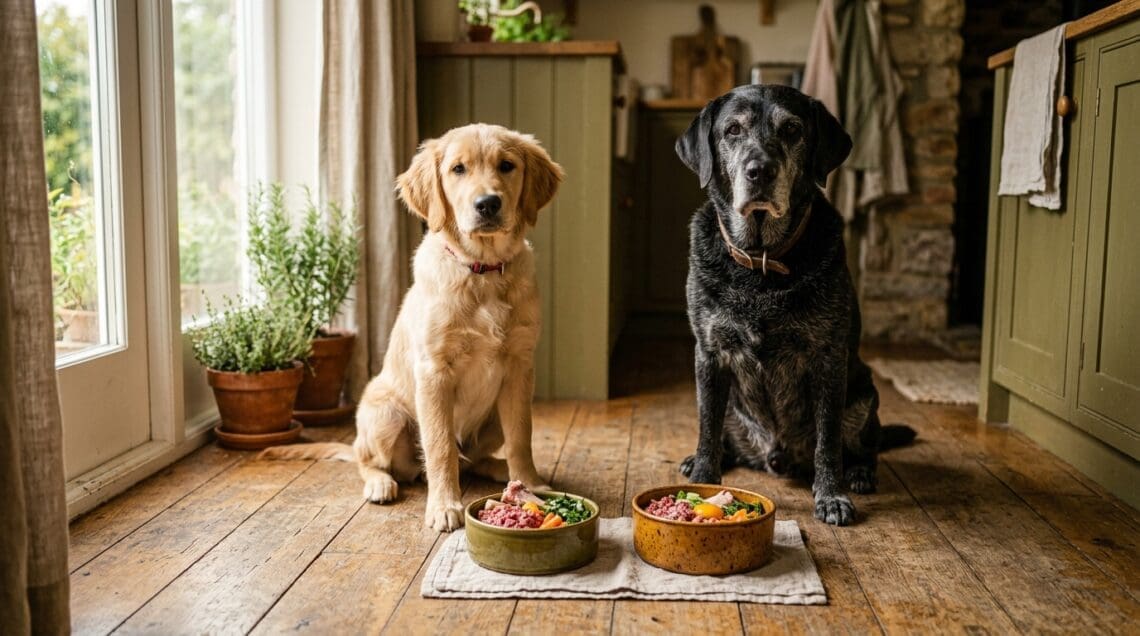
A puppy and a senior dog are not just small and old versions of the same animal. Nutritionally, they are almost opposites — one is building a body as fast as it safely can, the other is trying to hold onto the one it has. Feed them the same way and you get the same result from both ends of life: a dog that is over-fed, under-built, or quietly ageing faster than it should.
Raw, species-appropriate food doesn’t change between life stages. How much, how often, and what to watch does. Here’s what actually shifts, and why.
Puppies and Kittens: Building a Body Without Overbuilding It
The growth phase starts at birth, and during it a young animal needs more protein, more energy and more calcium per kilogram than it ever will again. The food has to be high quality and easy to digest — because a puppy’s stomach is tiny, and it can only eat so much at one sitting. Give it low-energy, bulky food and it physically cannot eat enough to meet its needs. The result is poor muscle and skeletal development and weaker growth.
So far, so obvious: feed puppies well. The part most people get wrong is the other direction.
Why “roly-poly” is the wrong goal
Overfeeding during growth is a problem, not a sign of success. Pushed too fast, growth predisposes large-breed dogs to skeletal problems and predisposes all animals to obesity. The goal is steady, adequate growth — not maximum growth.
This is where a counter-intuitive truth lives: pushing a puppy to grow as fast and as large as possible is not a head start — it’s a risk. Rapid overfeeding during growth is linked to developmental orthopaedic problems in large breeds, and sets up excess weight in a dog of any size. Keeping a growing pup lean, and letting it grow at a steady, moderate pace, is the healthier path. The cute roly-poly pup is not getting the ideal start.
The numbers worth tracking
Don’t judge a growing animal by eye — weigh it. Regular weighing tells you far more about whether the diet is working than a glance ever will:
- Kittens should gain roughly 50–100 g per week.
- Puppies should gain about 2–4 g per day for every kilogram of their expected adult weight, through the first five months.
- Most small and medium-breed pups reach about 50% of adult weight by four months.
Too slow a gain means more food, or better-quality food. Too fast means a less energy-dense meal. The scale, not the food bag, makes the call.
Calcium, phosphorus and the ratio that builds bone
Correct bone and teeth formation depends on the calcium-to-phosphorus ratio, and the optimal window is narrow: between 1:1 and 1.5:1. This is one of the strongest arguments for a properly formulated raw meal over a DIY mince-and-hope approach — a meal built around muscle meat, organ and finely ground bone lands in that window by design. (Green tripe, usefully, sits at a near-perfect calcium-to-phosphorus ratio on its own.)
How often to feed a growing animal
Small stomachs mean little and often. A practical rhythm:
- New pups and kittens usually arrive on four meals a day.
- Offer food for 10–20 minutes, then lift what’s left and offer fresh at the next meal.
- As they grow, they lose interest in one meal — drop it, and you’re on three.
- Later, drop another, and the growing animal settles to two meals a day.
One caution at homecoming: a new puppy or kitten is already under enormous stress — new home, no mother, no littermates. Changing the diet on the same day stacks more stress on top and often triggers digestive upset. Keep the original food for the first few days, then transition gradually.
Adult Maintenance: The Easy Years (Don’t Coast)
The adult phase — after growth stops, before ageing shows — is the least nutritionally demanding stretch of a pet’s life. For most animals (working dogs, toy breeds, and pregnant or nursing animals aside), a good-quality diet meets the need without fuss.
The catch is when it starts, because it varies wildly by size. Smaller breeds mature earlier and age slower, so the adult phase is most of their life. Large and giant breeds mature later and age faster, so theirs is short. As a rough guide, a dog is on adult feeding around the time it reaches adult height — roughly two years on average, nearer one year for small dogs, and as late as five years for the largest breeds. Cats run similar to small dogs: about one to seven years.
This is the stage to lock in the habit that protects the next one: match food to activity, and let body condition — not the bag’s feeding guide — set the amount. The numbers on the packet are recommendations, not prescriptions.
Reading body condition (the skill that replaces guesswork)
Body Condition Scoring (BCS) is a visual check that compares your pet’s shape to an ideal. The common scale runs 1–9:
- 1–3 (underweight): ribs, spine and bony points easily visible from a distance; little to no body fat or muscle.
- 4–5 (ideal): ribs easily felt under a light cover, a visible waist from above, an abdominal tuck from the side.
- 6–9 (overweight to obese): ribs hard to feel, no waist, fat deposits over the back and base of the tail.
Run your hands over your dog every week or two. The moment the waist starts to disappear, trim the portion — long before the scale makes it obvious.
Senior Pets: Managing the Long Slow Change
The senior stage runs from the end of maturity to the end of life — and for many animals that’s a third or more of the whole lifespan. It begins around 7–8 years in small dogs, about 5 years in large and giant breeds, and around 7 years in cats. Longevity breeds like the Border Collie or Jack Russell likely start later, though there’s little research to pin it down.
By definition, ageing means tissues and organs gradually become less efficient. That’s natural and unavoidable — but its pace is not fixed. Genetics and environment play a part, and so, heavily, do nutrition and nutritional history. An animal kept at its ideal weight on a good diet across its life enters its senior years with the most road left in front of it. The work you did at four months and four years is being cashed in now.
What changes, and what to do about it
The shifts are gradual — greying at the muzzle, stiffness after rest, slowing down — and easy to wave off as “just getting older.” Two are worth acting on rather than tolerating:
- Appetite and intake change. Smaller, more frequent meals often suit a senior better than one large bowl.
- Water intake changes. A noticeable rise in drinking (and the night-time waking it causes) is the kind of change to mention to your vet rather than just live with — it can be an early signal worth checking.
Weight management matters more now, not less, but with a softer hand: less exercise capacity and a slower metabolism mean portions usually need to come down to hold the same body condition. Keep scoring; keep adjusting.
A note on health conditions. Some seniors develop issues that call for veterinary input on diet. This article is about feeding the healthy animal well across its life — it isn’t a substitute for veterinary advice, and any pet with a diagnosed condition should be managed with a vet who is comfortable with raw feeding.
Key Takeaways
- ✅ Puppies need more protein, energy and calcium per kg — but lean beats roly-poly. Rapid overfeeding raises orthopaedic and obesity risk; steady, moderate growth is healthier.
- ✅ Weigh, don’t eyeball. Kittens ~50–100 g/week; puppies ~2–4 g/day per kg of expected adult weight for the first five months.
- ✅ Calcium:phosphorus belongs between 1:1 and 1.5:1 for correct bone and teeth — a reason to feed a properly formulated meal, not guesswork.
- ✅ Meal frequency steps down with age: 4 → 3 → 2 meals as the stomach grows.
- ✅ In adulthood, body condition score sets the portion — not the number on the bag.
- ✅ Senior onset is size-driven (~7–8 yrs small dogs, ~5 yrs giant breeds, ~7 yrs cats); feed smaller, more frequent meals and watch water intake.
- ✅ A lifetime at ideal weight is the single best thing you can do for a long, healthy old age.
Go deeper:
- The bigger picture: Why Raw Food for Dogs (see Ready to switch?)
- Getting the amount right: How Much Should I Feed My Dog in South Africa? and the Feeding Guidelines
- Already decided? Making the Switch: A Step-by-Step Transition Guide