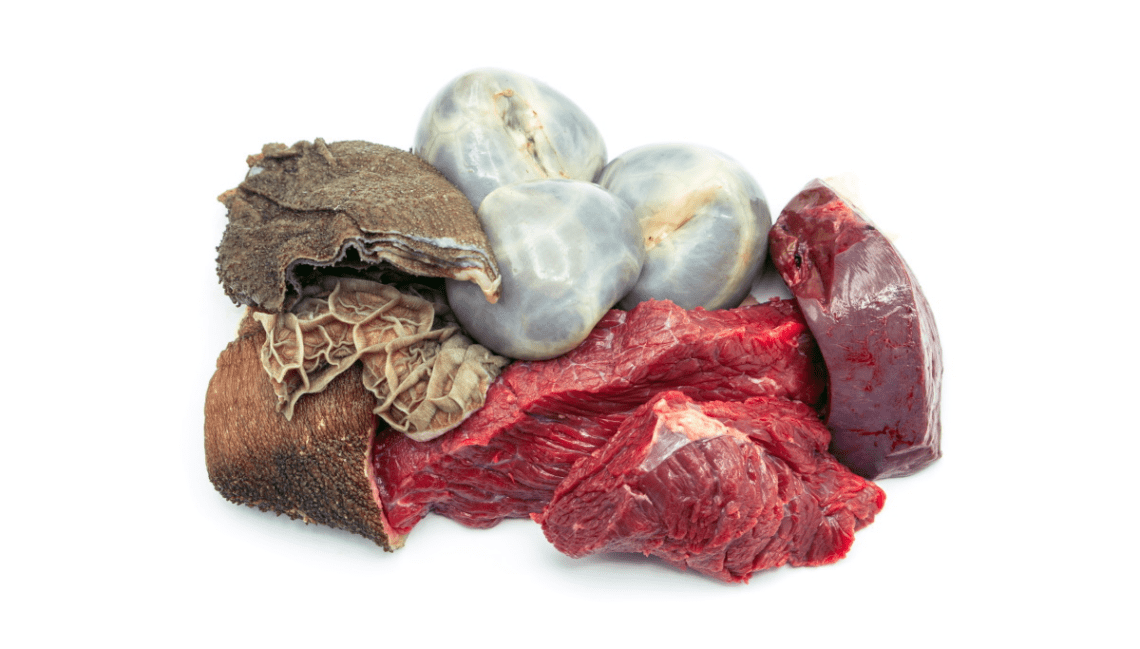
Most of us pull a face at the word “offal.” In a convenience-food world, liver, kidney and tripe have quietly vanished from our own plates — and from our pets’ bowls along with them. That’s a problem, because for a dog or cat, organ meat isn’t the throwaway part of the animal. It’s the most nutrient-dense food on the menu — the part a wild carnivore often eats first.
Why Carnivores Go for the Organs First
A dog in the wild is an opportunistic scavenger as much as a hunter, and when it brings down or finds prey, it doesn’t politely start with the lean muscle. It goes for the soft, meaty organs. Partly that’s because they’re easy to reach — but it’s also because organ meat carries some of the highest concentrations of essential nutrients in the entire animal. Muscle meat and bone are important, but they don’t, on their own, deliver everything a body needs. The organs fill the gaps.
Modern farming makes this matter more, not less: today’s muscle meat can be lower in some nutrients than the wild equivalent, so the organ portion of the meal does real work.
What’s Actually In It
Organ meat is a concentrated multivitamin in its natural form. Across the different organs you’ll find:
- A full spread of B vitamins — B12, B1 (thiamine), B2, B5, B6 — plus biotin and choline.
- Fat-soluble vitamins A, D, E and K, omega fatty acids, and key minerals.
- High-quality, highly usable protein.
A few organs deserve their own mention:
- Heart — technically a muscle, but a special one. It’s rich in taurine, an amino acid that’s essential for cats and important for dogs. Taurine’s significance isn’t a fringe claim: a famous body of work established that taurine deficiency causes dilated cardiomyopathy (DCM) — a serious heart-muscle disease — in cats. Heart is one of nature’s best taurine sources. It also carries CoQ10, selenium, zinc and thiamine.
- Liver — the nutritional powerhouse: exceptionally high in vitamin A, copper, iron and B vitamins. So rich, in fact, that it’s the one organ you can over-do (more on that below).
- Kidney, spleen, brain, sweetbreads, lung — each adds its own profile of minerals and micronutrients; variety across them is the point.
A Special Case: Green Tripe
One organ earns a guide of its own. Green tripe — the unbleached stomach lining of grazing animals — is a quiet superfood, carrying both beneficial gut bacteria and the material that feeds them. (The bleached white tripe on the supermarket shelf has had all of that scrubbed out of it.) Because there’s so much to say about it, we’ve given it its own page: Tripe, the Magical Mystery Meat. It’s smelly. Your dog will adore it.
So How Much Organ Should I Feed?
You’ll see a popular rule of thumb: 5% liver and 5% other secreting organ of the total diet. It’s a reasonable starting frame — but treat it as a guide, not gospel. Hitting “5% liver” doesn’t guarantee you’ve balanced every nutrient; you can still end up with too much of one thing or too little of another. The principle that actually matters is balance over time.
Feeding organ meat well — the practical rules
- Variety beats precision. Rotating through different organs over a week or a month matters more than nailing an exact daily percentage. No single meal has to be perfect.
- Go easy on liver. It’s so rich in vitamin A that too much, too often, can tip into excess. A little, regularly, is the sweet spot — not a liver-heavy bowl every day.
- Introduce slowly. Organ meat is rich, and a sudden big serving can mean loose stools. Start small and build up as your pet adjusts.
- Organs as toppers and treats work well, not just as part of a full meal.
- Don’t have access to the full range? A complete, balanced commercial raw meal already accounts for the organ portion — you don’t have to source spleen and sweetbreads yourself to get it right.
If you’d like the bigger picture of how organ, muscle, bone and the rest fit together into a balanced bowl, see our companion guide on what makes a raw meal “complete”.
Key Takeaways
- Organ meat is the most nutrient-dense part of the animal — wild carnivores eat it first for good reason.
- Heart = taurine, the amino acid essential for heart health (its deficiency causes DCM in cats).
- Liver is the powerhouse — and the one to feed in moderation, because of its vitamin A.
- Green tripe is a standout organ with its own guide — the unbleached version is a natural probiotic; the supermarket kind isn’t.
- “5% + 5%” is a guide, not a guarantee. Aim for variety and balance over time, and introduce richer organs slowly.
- A complete commercial raw meal already includes the organ portion — you don’t have to assemble it all yourself.
Sources
- Pion PD, Kittleson MD, Rogers QR, Morris JG. Myocardial failure in cats associated with low plasma taurine: a reversible cardiomyopathy. Science. 1987;237(4816):764–768. doi:10.1126/science.3616607
- National Research Council. Nutrient Requirements of Dogs and Cats. Washington, DC: National Academies Press; 2006. doi:10.17226/10668
* Disclaimer: This information is for educational purposes only and is not intended to replace the advice of your own veterinarian or doctor.