A pet-food label is the one document the industry is legally required to give you — and the one it has become expert at writing so you’ll misread it. Nothing on a well-made label is technically a lie. It doesn’t have to be. The persuasion is in the order, the definitions, and the words that sound like guarantees but aren’t.
Once you can see the techniques, you can’t un-see them. Here’s how to read past the front of the bag.
Trick 1: The First-Ingredient Game (Ingredient Splitting)
Most shoppers use one rule: look at the first ingredient. Ingredients are listed by weight, so a named meat at the top feels like proof the food is meat-based. Marketing departments know this is your rule — so they game it.
The technique is called ingredient splitting. A single cheap ingredient — say, a carbohydrate — is divided into several sub-types (ground corn, corn gluten, corn bran, and so on) and each is listed separately. Because each fraction now weighs less than the meat, meat climbs to the top of the list — even though, added back together, the carbohydrate may outweigh everything. The first-ingredient rule has been turned against you.
What to do: read the whole list, not the first line. Mentally recombine split ingredients. If three or four entries are variations of the same grain or legume, treat them as one big one — and ask where it would really rank.
Trick 2: What “Meat” Is Actually Allowed to Mean
This is where definitions do the hiding. On an ingredient panel, the word “meat” (or “poultry”, or “fish”) with no animal named in front of it is a category, not a promise. It can legally come from almost any animal source — including, in many jurisdictions, material from animals that were diseased, decayed, dead or dying (often shorthanded as 4D). Animal by-products such as grease and feathers may be processed in the same facilities, and recipes — even across “premium” and budget labels from the same maker — are not always kept separate. The expensive bag may share a production line, and contents, with the cheap one.
A short glossary cuts through most of it:
- Named protein (“chicken”, “beef”, “salmon”, “lamb”): a real, named species — the least processed and the kind you actually want to see.
- Unnamed “meat / poultry / fish”: a category, not a species. Treat with suspicion.
- “Meal” (e.g. “chicken meal”): the ingredient ground up with its water removed — concentrated, and not inherently bad if the species is named.
- “By-product” / “by-product meal”: the rendered, ground leftovers of the carcass — necks, feet, intestines and the like. Quality varies enormously, and an unnamed by-product tells you very little.
What to do: look for named species at the top and be wary of unnamed “meat” and unnamed by-products.
Trick 3: The Guaranteed Analysis Tells You Less Than It Seems
Every label carries a guaranteed analysis — typically minimum protein and fat, maximum fibre and moisture. It’s a useful starting point, but notice what’s missing: carbohydrate is not required to be listed. In a product built by extrusion, something has to bind the “dough” — usually starches and legumes, often in large quantities — yet that carb load can sit invisibly outside the guaranteed analysis. Only a detailed laboratory analysis shows the true protein-to-fat-to-carbohydrate ratio.
There’s a second quiet tell in the vitamin line. Vitamins are added to processed food to replace what high-heat cooking destroys. Unstated vitamin sources are often a sign of synthetic vitamins — and not every synthetic form is equally usable by your pet’s body. The presence of a long added-vitamin list is itself a clue about how much the original ingredients went through.
What to do: if protein and fat are modest and the moisture is low, assume the gap is carbohydrate. A long list of added synthetic vitamins is a sign of heavy processing, not generosity.
Trick 4: The Words That Sound Like Guarantees but Aren’t
Some of the most persuasive words on a bag are the least defined:
- “Natural” does not mean organic — and the gap is wide. A “natural flavour” can be created from rendered fats or grease, and may itself be artificially preserved afterwards. Companies rely on the confusion between the two words.
- “Premium”, “gourmet”, “holistic” have no enforced definition on pet food. They describe a price position, not a recipe.
- “Complete and balanced” is meaningful — but it’s a formulation claim against a nutrient profile, not a statement about ingredient quality. A food can be “complete and balanced” and still be built largely from cheap, heavily processed material.
What to do: treat undefined adjectives as marketing, and look for the specific, checkable facts instead — named species, recombined ingredient order, the real carb picture.
Who Actually Regulates This?
In South Africa, more than most label-reading advice will tell you — because that advice is usually written for the United States, where the often-cited Association of American Feed Control Officials (AAFCO) is a voluntary body with no regulatory authority of its own. It sets standards others may adopt; it does not police the bag.
Our system is the opposite — mandatory, and run by government. Pet food is regulated as a “farm feed” under the Fertilizers, Farm Feeds, Agricultural Remedies and Stock Remedies Act, 1947 (Act 36 of 1947), administered by the Department of Agriculture, Land Reform and Rural Development (DALRRD) through its Directorate of Agricultural Inputs Control and the Registrar of Act 36. Every food sold as a complete diet must be registered: its full formulation is evaluated, its label has to comply, and imported brands must clear the same bar. Alongside the Act, the SANS 909 dog-and-cat-food standard (maintained through the SABS) governs labelling and composition, and the Consumer Protection Act covers misleading claims.
That hands South African pet owners a check the rest of the world doesn’t have, and it takes one second: look for the V-number — printed as “V####” next to the words “Act 36 of 1947.” It is the proof that a complete food is legally registered, renewed every three years; a product sold as complete without one should not be on the shelf at all. (The 1947 Act is itself being modernised — a new Feed and Pet Food Bill has been drafted to replace it.)
Even so, the V-number isn’t the whole story — and that’s why label-reading stays a skill worth having. Registration confirms a food meets a nutrient profile on paper; it says nothing about ingredient quality, or how heavily the food was processed. The V-number tells you a product is legal and complete. The techniques above tell you whether it’s good.
The 5-Step Label Read
Put it together into a routine you can run in the aisle:
- Ignore the front of the bag. The pictures and adjectives are advertising. Turn it over.
- Read the whole ingredient list and recombine the splits. Group every variant of the same grain/legume and ask where that total really ranks.
- Find a named species. “Chicken” beats “meat”; an unnamed by-product is a red flag.
- Reality-check the guaranteed analysis. Low protein/fat + low moisture = a hidden carbohydrate load.
- Discount the undefined words. “Natural”, “premium”, “holistic” carry no enforced meaning — set them aside and judge the checkable facts.
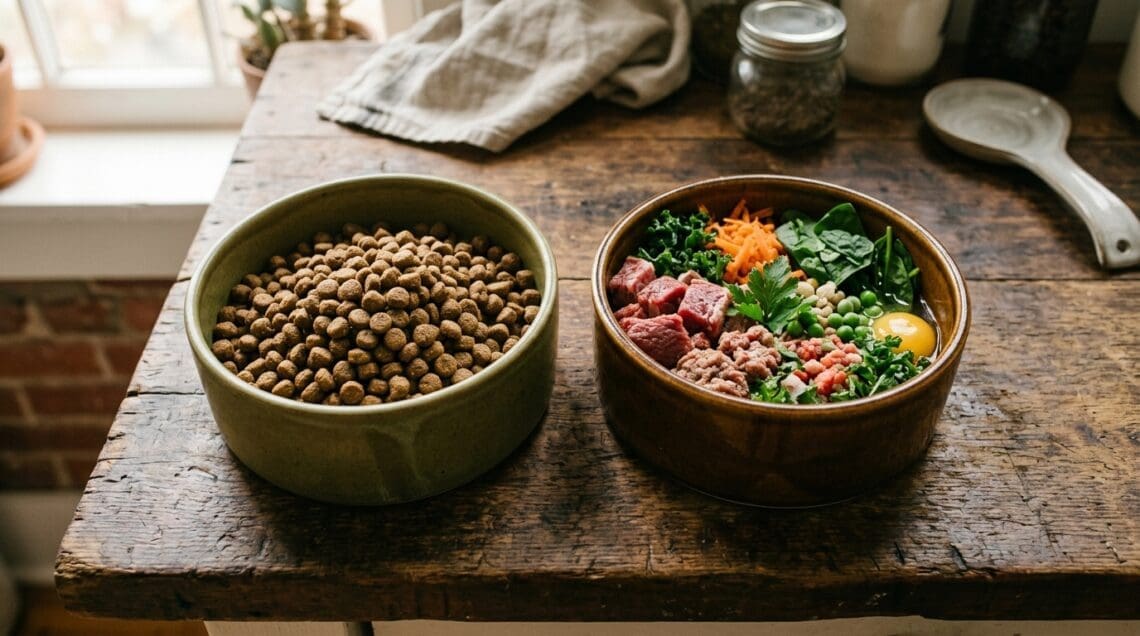
The deeper you go, the simpler the conclusion gets. The reason a fresh, raw, named-species meal needs so little label decoding is that there’s almost nothing to decode: you can read the whole recipe and recognise every word in it. When a label needs a translation guide, that is the information.
Key Takeaways
- ✅ Ingredient splitting divides one cheap ingredient into fractions so meat floats to the top — read the whole list and recombine.
- ✅ Unnamed “meat” is a category, not a species — and may include 4D material and by-products; look for named species.
- ✅ “Meal” is fine if the species is named; unnamed by-products are not.
- ✅ The guaranteed analysis hides carbohydrate — low protein/fat + low moisture means the rest is filler.
- ✅ “Natural” ≠ organic; “premium/holistic” mean nothing enforceable — judge the checkable facts.
- ✅ AAFCO has no regulatory authority — “meets AAFCO standards” is a formulation benchmark, not a quality guarantee.
- ✅ In South Africa, look for the V-number and “Act 36 of 1947” on the pack — mandatory proof a complete food is legally registered (unlike the voluntary US system).
- ✅ The less a label needs decoding, the better the food — a named-species raw recipe reads in plain words.
Go deeper:
- The bigger picture: Why Raw Food for Dogs (see How the industry hides it)
- How Pet Food Companies Legally Deceive You
- Carbohydrates in Pet Food: How Much Is Too Much?