Wondered whether tripe would do your dog any good? A staple human food across Africa, the UK and Asia, tripe is nothing new — but it’s quietly become one of the best things you can put in a pet’s bowl. With one important catch: the tripe that’s good for your pet is not the tidy white stuff at the supermarket.
What Is Tripe?
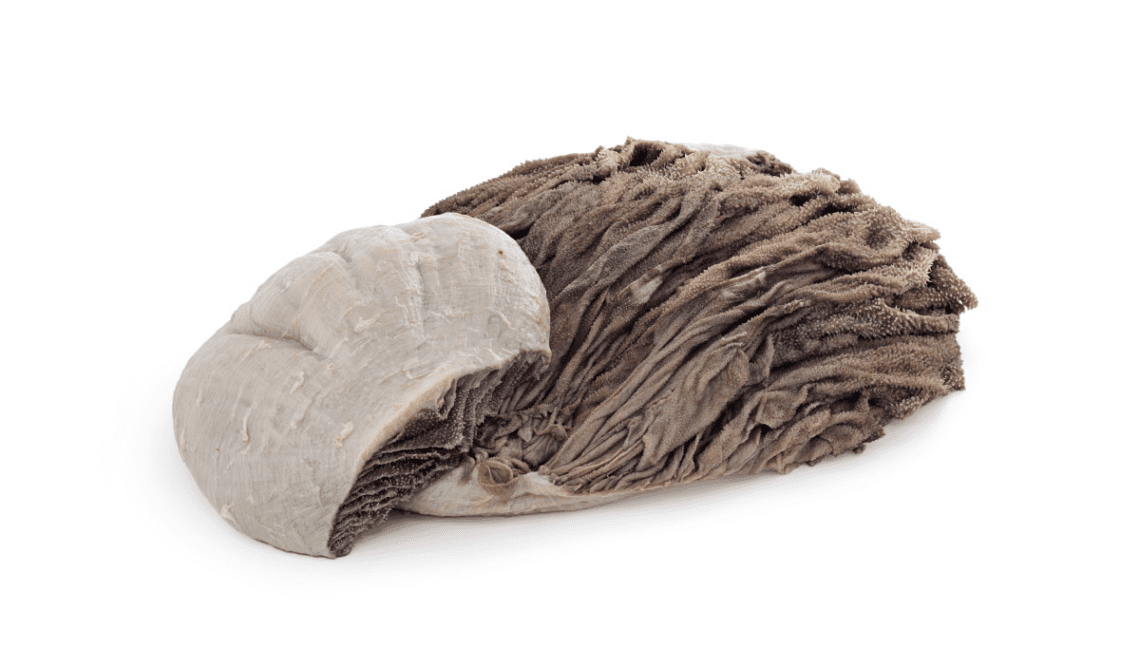
Tripe is the edible lining of a grazing animal’s stomach — most often cattle, sheep or goat. People eat it the world over. But the version that benefits your pet is processed completely differently from the kind destined for a human plate.
White vs Green Tripe — Only One Is Any Use
- Supermarket (white) tripe has been cleaned, scalded and bleached for human dishes. It looks tidy — and it’s nutritionally close to worthless for your pet.
- Green tripe is the untreated version, usually only lightly rinsed. It keeps the partially digested plant matter and the living gut bacteria from the animal’s stomach — which is exactly what makes it valuable. (“Green” refers to its untreated state, not its colour: it’s actually mostly brown.)
What’s in Green Tripe
For a carnivore, green tripe is one of those rare single foods that does several jobs at once.
- Natural probiotics. Green tripe carries Lactobacillus acidophilus — a beneficial bacterium that helps the good microbes in the gut compete with the unwanted ones. A controlled feeding study in healthy dogs found this strain established in the gut and supported a favourable microbial balance — one of the clearest reasons tripe earns its reputation as a gut food.
- Digestive enzymes. Because it comes from a working stomach, green tripe arrives with its own enzymes, which help the body get more out of the rest of the meal.
- Partially digested greens. The grazing animal has already done the hard work of breaking plant matter down, so your carnivore gets plant nutrients in a form it could never extract from grass itself.
- A balanced mineral and fat profile. Green tripe has a near-ideal calcium-to-phosphorus ratio and a good balance of omega-3 to omega-6 fats — unusual in a single whole food.
A note on the vitamins: green tripe delivers its nutrients in their natural food matrix, alongside the other compounds they travel with, rather than as an isolated premix. We won’t claim whole-food vitamins are always better absorbed than synthetic ones — for some nutrients they’re equivalent — but a real, whole food doesn’t depend on a synthetic top-up to rescue what processing strips out.
Who It Suits, and How to Use It
- Picky eaters and seniors. Green tripe’s strong aroma — unpleasant to us, irresistible to dogs — makes it a reliable way to tempt a fussy appetite, and it’s especially handy for older pets whose sense of smell has faded.
- Pets building or holding condition. It packs nutrient-dense calories, so it suits a dog that needs to put on healthy weight — and because those calories come with real nutrition and satiety, a little also works as a topper on a weight-management plan.
- Sensitive stomachs. Being partially pre-digested and mildly acidic, green tripe tends to be gentle and well tolerated.
- A natural chew. In larger fresh or freeze-dried pieces it has a rubbery texture dogs enjoy working on — good for keeping them occupied.
- Some feeders also reach for it with grass-eaters and poop-eaters; the evidence there is anecdotal, but it’s a harmless thing to try alongside addressing the usual behavioural causes.
Feed it as part of a meal, a topper, or a standalone treat — frozen into cubes or as freeze-dried morsels.
What to Look For When You Buy
- Grass-fed or free-range source rather than feedlot.
- Minimally processed — fresh is best, then frozen, then freeze-dried.
- Locally sourced where possible, for production and safety standards you can stand behind.
One firm rule: never thaw tripe in the microwave — unless you’d like the smell to follow you around for a week. Serve it (nose pinched, if you must), and your dog will think you’ve finally understood them. For where tripe fits into the rest of the bowl, see The What and Why of Organ Meat and What Makes a Raw Meal “Complete”.
Key Takeaways
- Green tripe, not white tripe — the bleached supermarket version has had the goodness scrubbed out.
- It’s a natural probiotic and enzyme source — L. acidophilus plus the animal’s own digestive enzymes.
- It unlocks plant nutrients a carnivore couldn’t extract from grass, with a near-ideal calcium-to-phosphorus ratio.
- Great for picky eaters, seniors, and pets building condition — and gentle on sensitive stomachs.
- Buy grass-fed, minimally processed and locally sourced — and never microwave it.
Sources
- Baillon ML, Marshall-Jones ZV, Butterwick RF. Effects of probiotic Lactobacillus acidophilus strain DSM13241 in healthy adult dogs. American Journal of Veterinary Research. 2004;65(3):338–343. doi:10.2460/ajvr.2004.65.338
- Sandri M, Dal Monego S, Conte G, Sgorlon S, Stefanon B. Raw meat based diet influences faecal microbiome and end products of fermentation in healthy dogs. BMC Veterinary Research. 2017;13(1):65. doi:10.1186/s12917-017-0981-z
* Disclaimer: This information is for educational purposes only and is not intended to replace the advice of your own veterinarian or doctor.